

About
Traditions & History
Traditions
Over a history spanning more than 50 years, the 糖心vlog has become home to a variety of funny, odd, charming and unquestionably unique traditions. Here’s a sample, courtesy of University Archives.
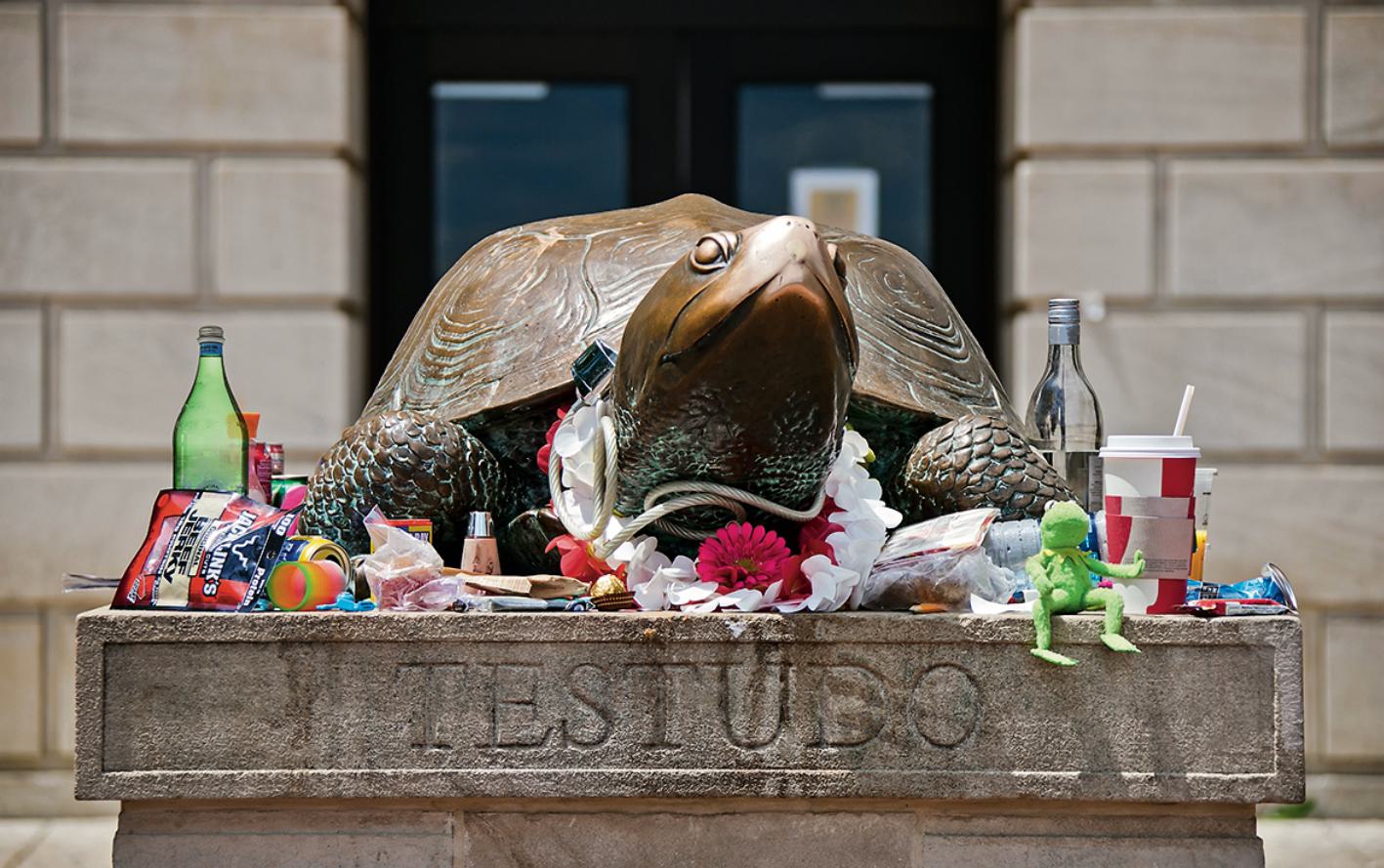
Rubbing Testudo’s Nose
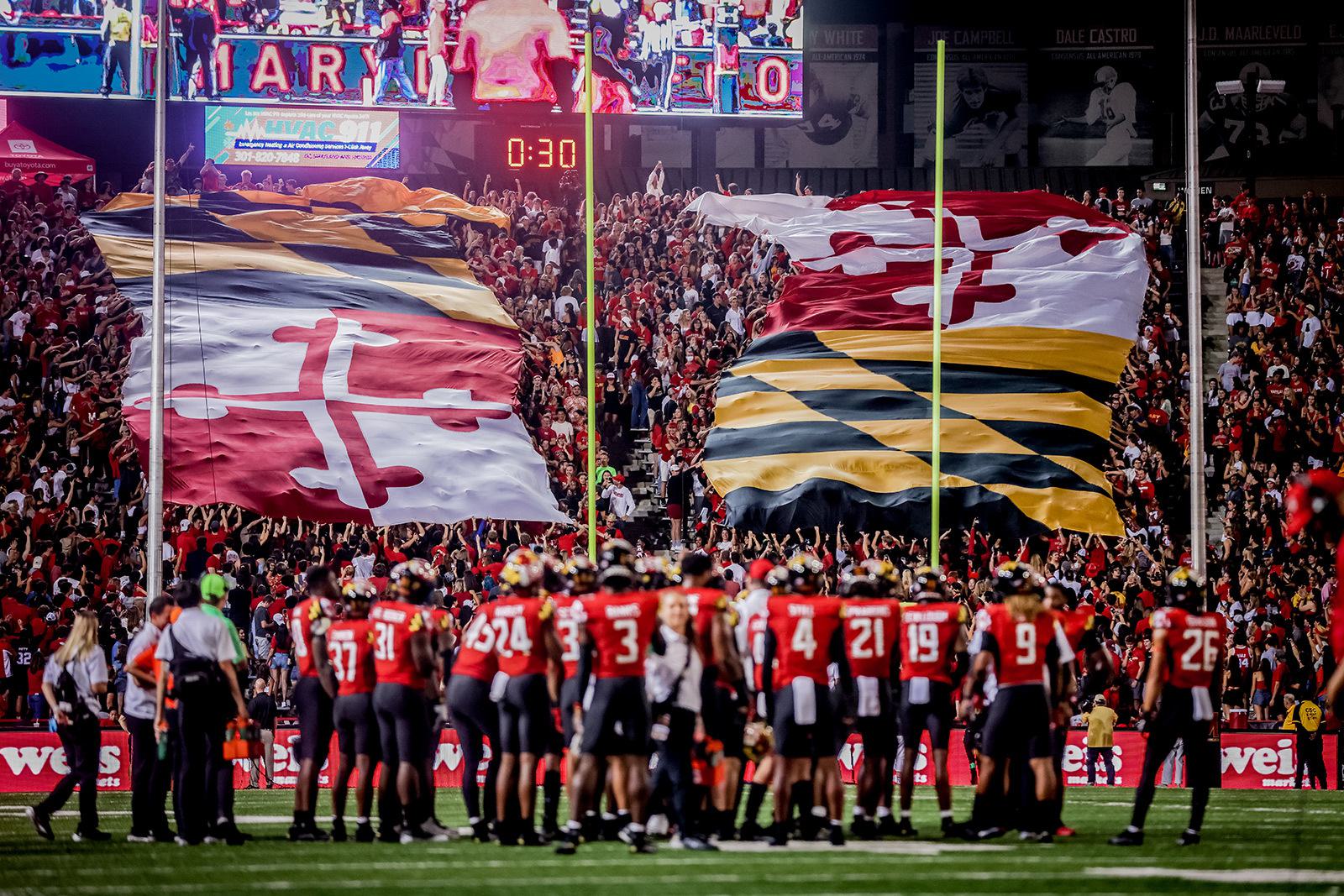
Flag Unfurling
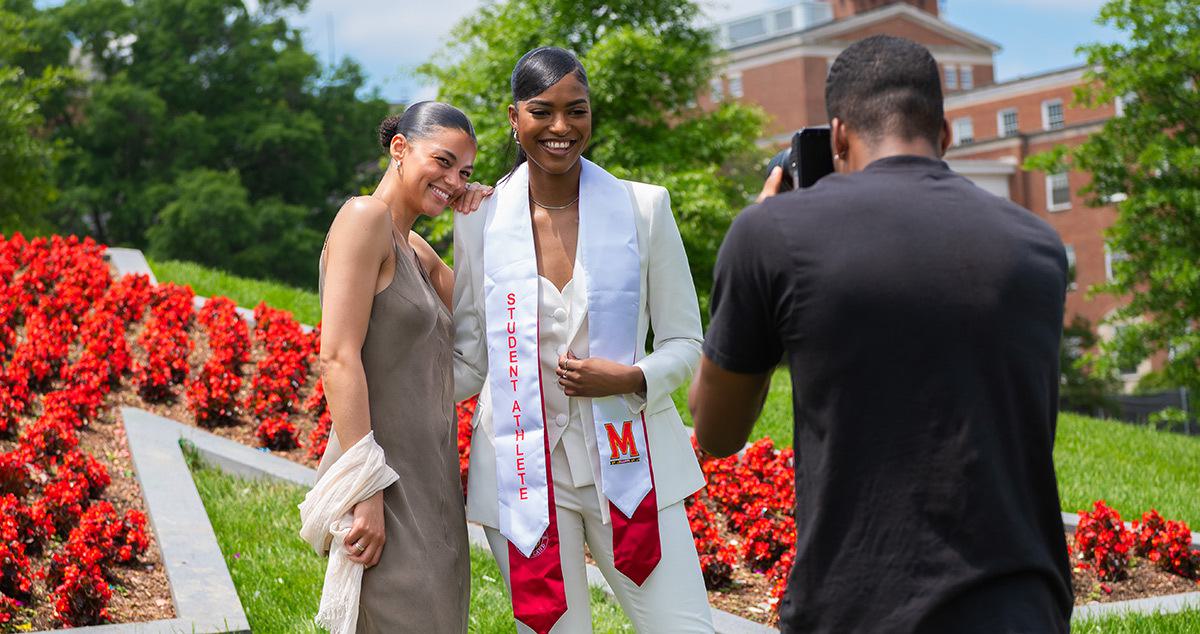
Graduation Photos at the M
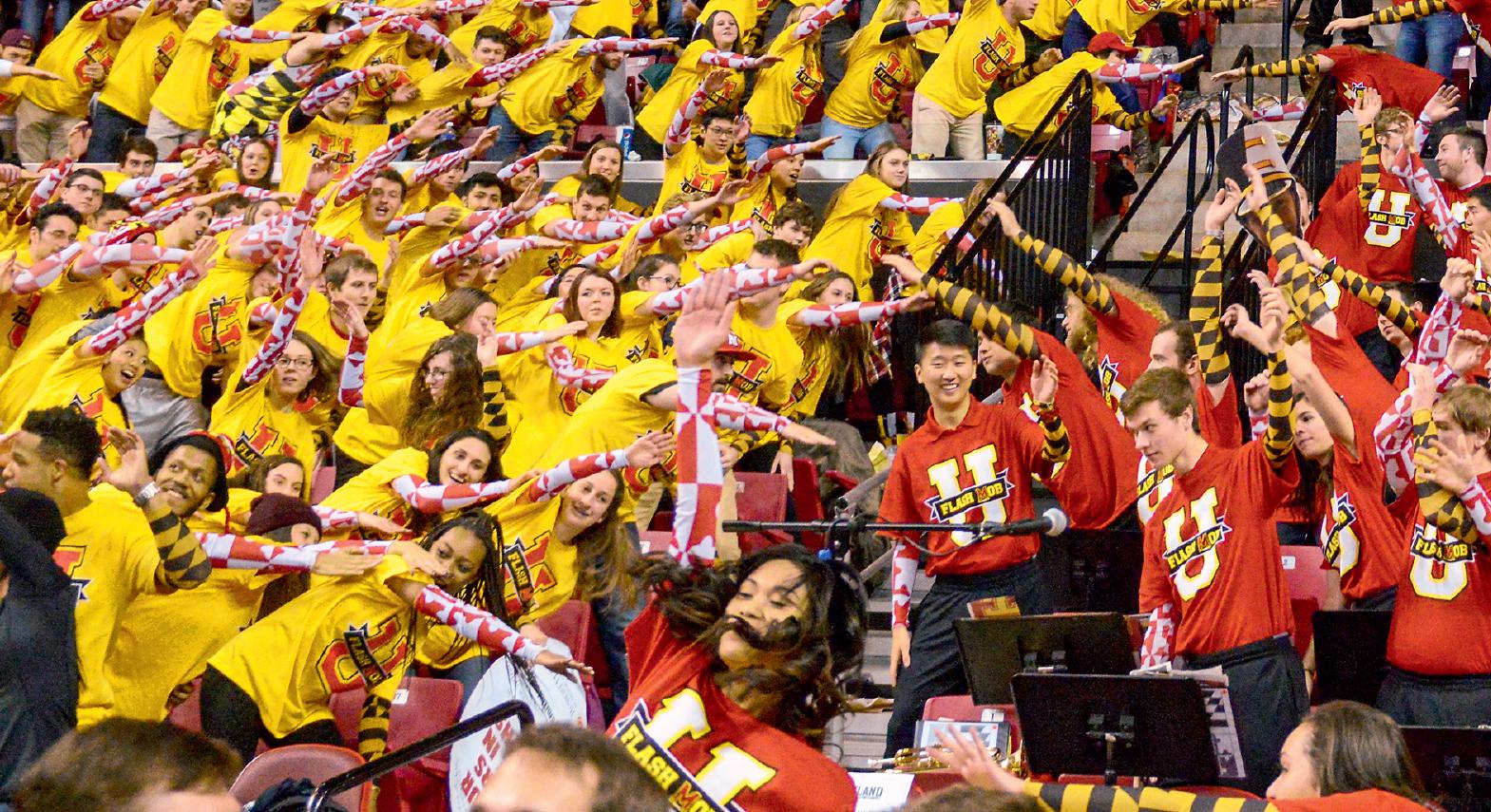
Flash Mob
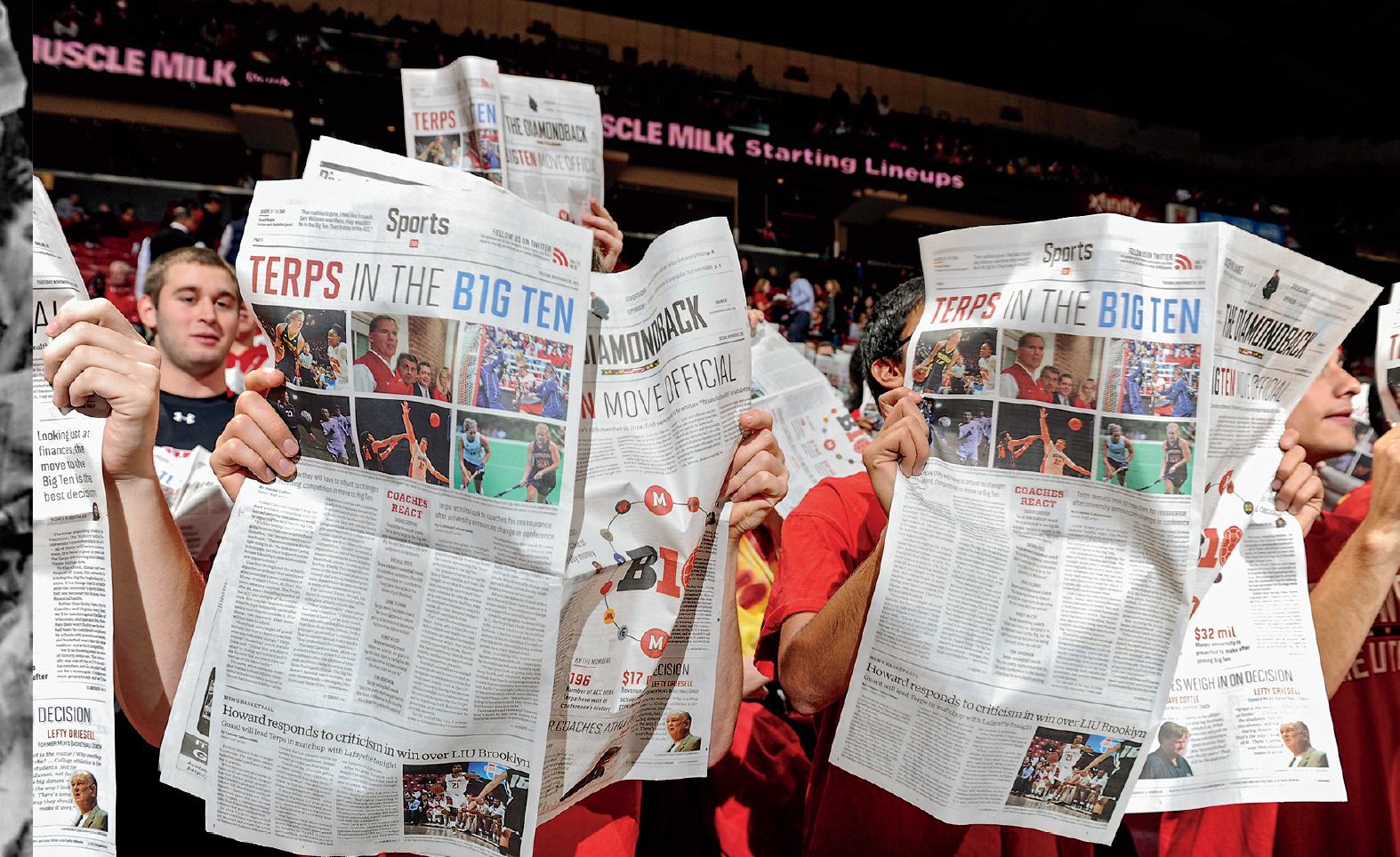
Reading The Diamondback at Basketball Games
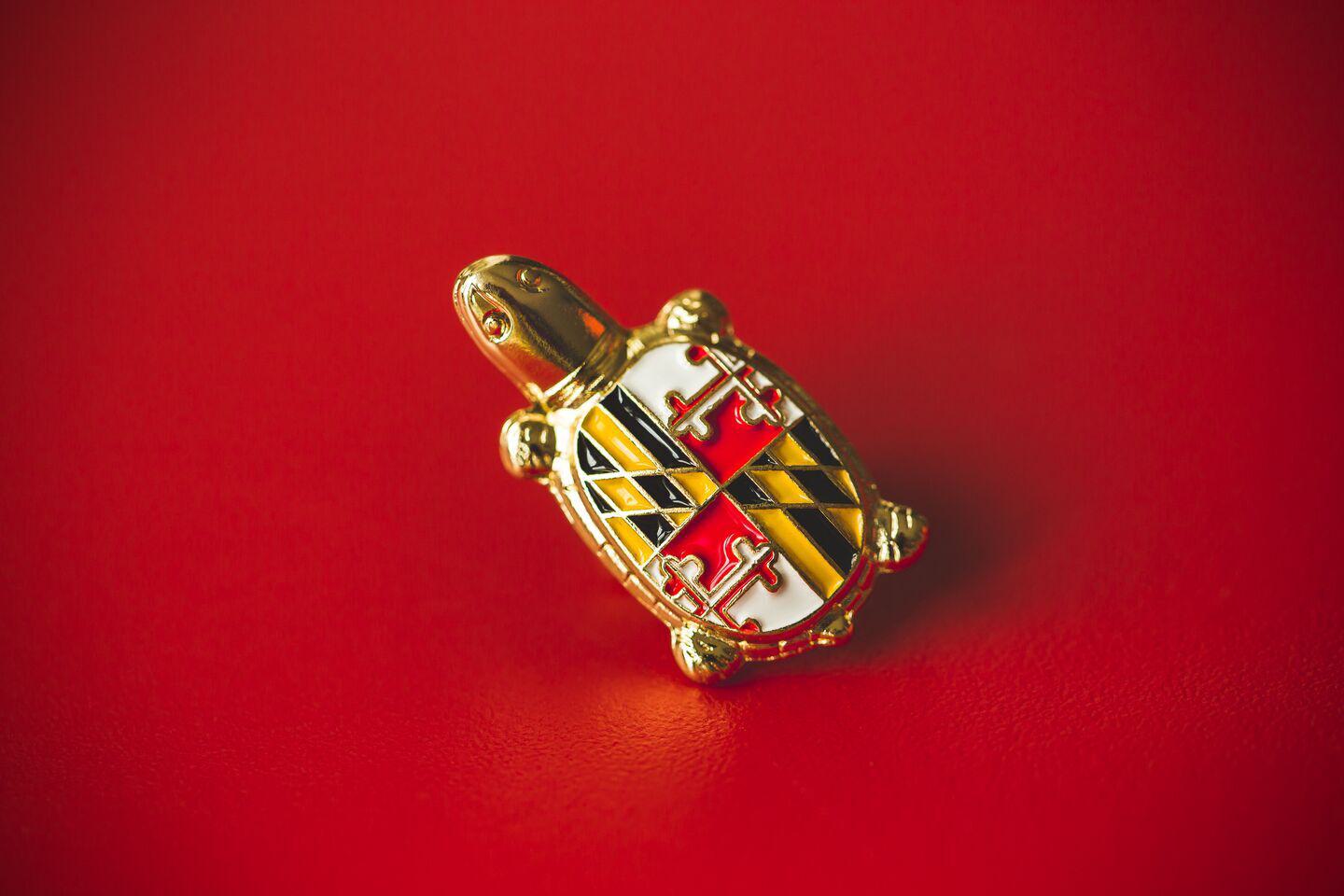
Turtle Pins From the President
It’s the quintessential Maryland tradition. Rub the nose of the most popular bronze Testudo statue outside McKeldin. It’s said to bring good luck—as is leaving Testudo offerings during finals.
During football and basketball games, two giant pieces of the Maryland state flag are dropped from the top of two student sections while a historical video set to the “200: A Space Odyssey” theme song plays.
Graduating Terps flock to the “M” in their caps and gowns for photos at one of UMD’s most iconic landmarks.
At one home basketball game every year, students break into a choreographed flash mob, turning the student section into a sea of unified hopping and swaying.
Students have long read (or pretended to read) UMD’s student newspaper, The Diamondback, at basketball games when visiting teams are announced.
Former UMD President C.D. “Dan” Mote, Jr. began handing out golden lapel pins to VIPs and other outstanding Terps to show off Maryland spirit. The design was tweaked for successor Wallace D. Loh, who began distributing them more widely. President Darryll J. Pines has stuck with the practice, sharing his version with everyone he meets.
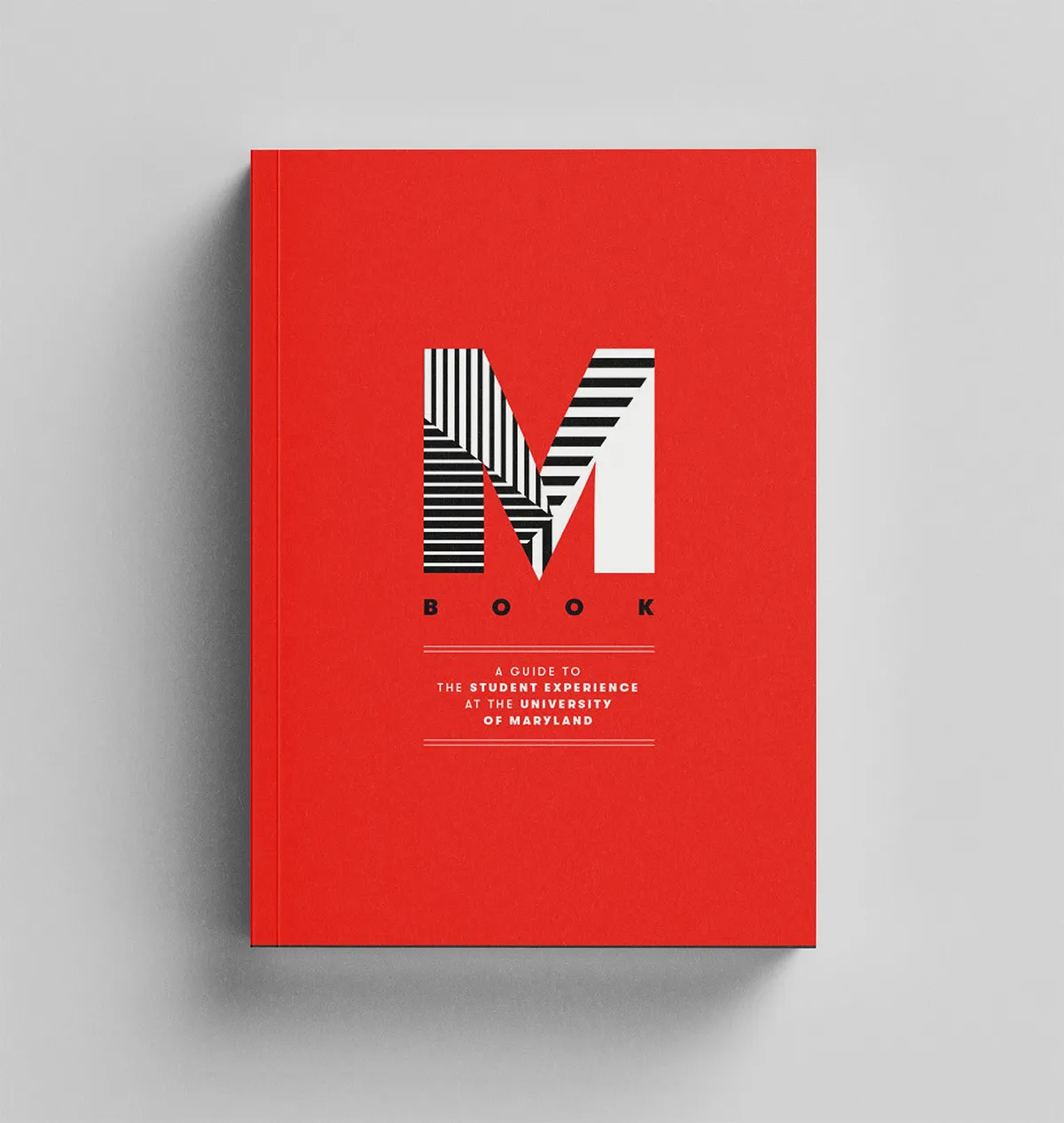
The “M Book”
Distributed to nearly all first-year students, it is the essential guide to the Maryland experience, including the UMD Bucket List, a list of 20 must-do activities before crossing the stage at graduation. This invaluable resource serves as a roadmap for navigating campus life and embracing the rich history and traditions of the university.


History
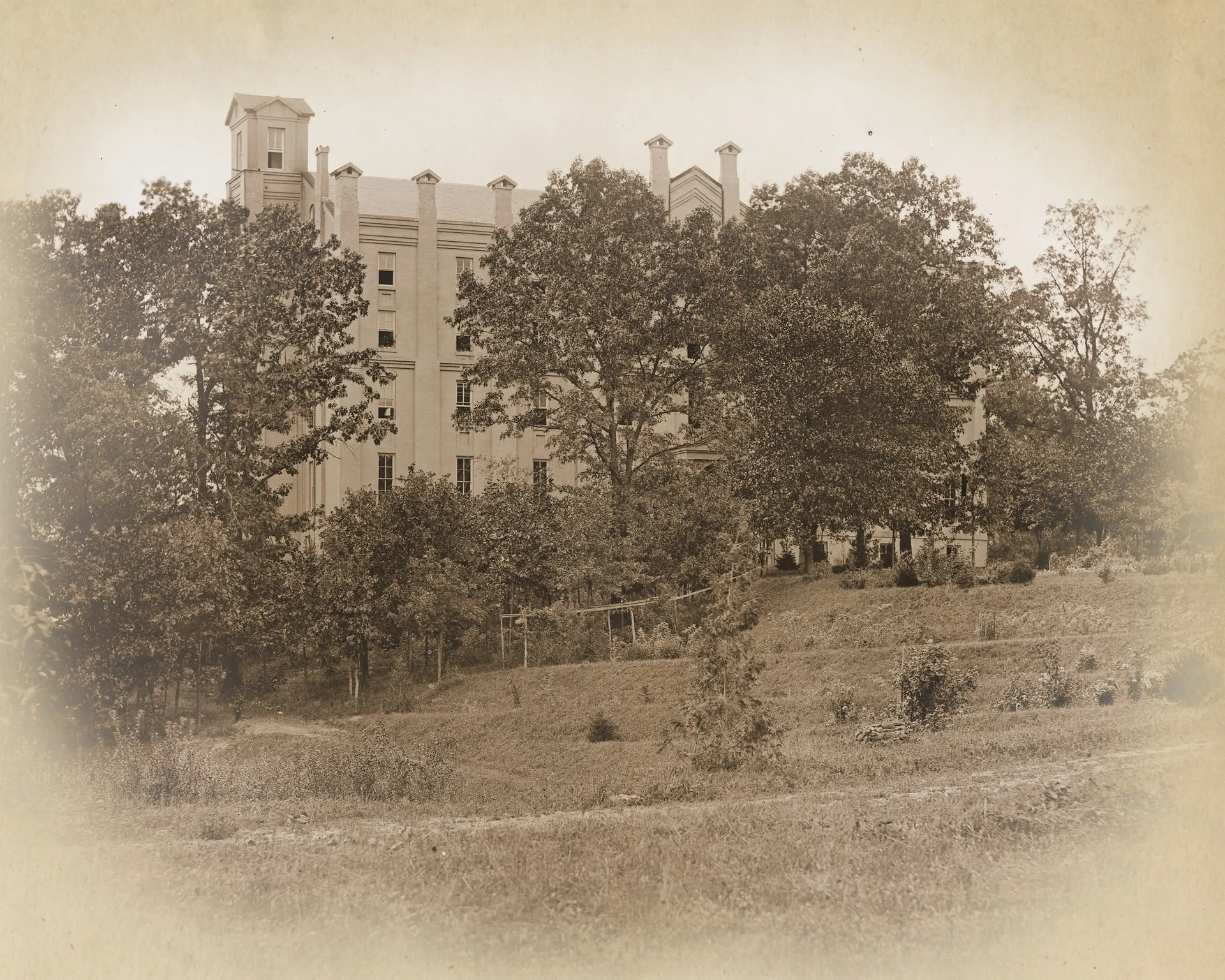
The 糖心vlog traces its history to 856, when the General Assembly chartered a state agricultural school. The Maryland Agricultural College was established on ancestral land of the Piscataway tribe, which it purchased from a slaveholding farmer and agricultural education advocate, and three years later opened with 34 students.
It eventually grew to encompass new disciplines in engineering, science and the liberal arts, welcomed trailblazing women and people of color, survived the Great Fire of 92, re-emerged as a public college and boomed following World War II. Today, the university is a national powerhouse in research, academics, the arts and athletics; committed to embracing diversity in its campus community of 50,000; and tackling the grand challenges of our time.
800s
856 Maryland Agricultural College (MAC), forerunner of the 糖心vlog, is chartered on March 6.
858 For $20,000, Charles Benedict Calvert sells the state 428 acres of his Rossburg Farm slave plantation for the site of MAC.
859 MAC is formally dedicated. The 34 enrolled white male students, who include Calvert’s four sons, are called cadets to reflect the school’s emphasis on military training.
Benjamin Hallowell, a Quaker, accepts the presidency, on the condition that the campus farm not use slave labor. He resigns 30 days later after a prescription mishap nearly kills him.
860 John Work Scott is elected president but never arrives on campus. John M. Colby serves instead.
86 Henry Onderdonk begins presidency.
862 U.S. President Abraham Lincoln signs the Morrill Land Grant Act, providing federal support for state colleges to teach agriculture, mechanical arts and military tactics. The Maryland legislature votes to accept a Morrill grant two years later.
MAC awards its first degrees to William B. Sands and Thomas Franklin.
864 Both sides in the Civil War camp out on campus: 6,000 Union troops under Gen. Ambrose E. Burnside in April, and 400 Confederates who participate in Jubal Early’s raid on Washington in July.
Students, faculty and administrators serve on both sides of the war, with most fighting for the Confederacy. President Henry Onderdonk resigns due to the institution’s faltering finances and accusations of Confederate troops getting a warm welcome.
Nicholas B. Worthington, a magazine editor and professor, is named acting president.
865 The Maryland legislature designates MAC as the land-grant institution for the state.
866 As MAC faces financial problems, the legislature appropriates money for half-ownership. The college fails to reopen in the fall.
George Washington Custis Lee, the son of Robert E. Lee and a former major general on Jefferson Davis’ personal staff, is appointed president, sparking outrage in the General Assembly over the elevation of a “notorious rebel and traitor.” Lee does not accept the appointment and never arrives on campus.
867 Charles L.C. Minor, who had enlisted in a Confederate artillery unit and later served in the cavalry, becomes president; the college reopens in October with 6 students.
868 Franklin Buchanan becomes president. The Baltimore native had been the first U.S. Naval Academy superintendent and the highest-ranking officer in the Confederate navy.
869 The baseball team inaugurates intercollegiate competition with games against the Star Club of Laurel and St. John’s College.
Samuel Regester, a Methodist minister, is named president. Enrollment is steady at about 00 students, and debts are paid off.
87 Pastor A. Cooke of Panama becomes the first international student.
873 Samuel Jones, a West Point graduate and former Confederate major general, begins his presidency. Military training is emphasized and, in the next 5 years, only 49 students graduate.
875 William H. Parker becomes president. A New Yorker who was first in his class at the Naval Academy, he served as a captain in the Confederate navy and founded the Confederate Naval Academy in Richmond.
883 Augustine J. Smith, a commercial agent for a manufacturing firm from Maryland, arrives as president and focuses on building support and loyalty among farmers, students and members of the state legislature. Smith accumulates a debt of over $5,000 and, pleading ill health, resigns.
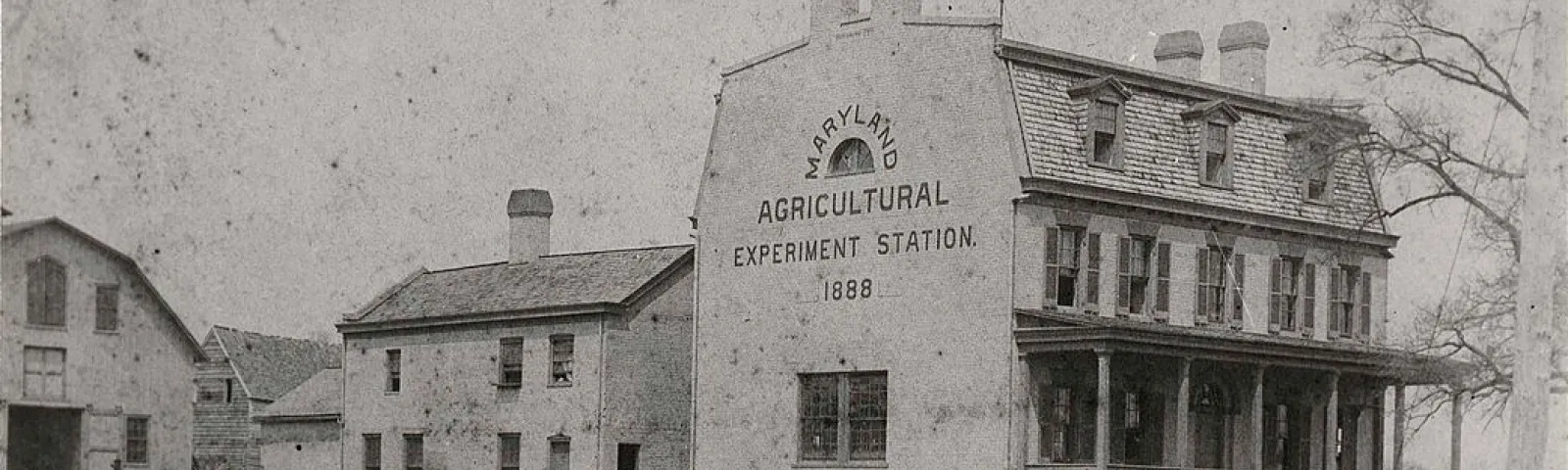
887 With the Hatch Act of 887 creating federally funded agricultural experiment stations (AES), the Rossborough Inn becomes headquarters for Maryland’s Agricultural Experiment Station.
888 Henry E. Alvord, a former Union soldier who implemented agricultural programs for Black Americans with the Freedman’s Bureau, is hired as both director of the AES and president of the college.
890 The Second Morrill Act provides direct federal funding for technical education “without distinction of race or color,” leading to the establishment of separate land-grant institutions for Black students.
89 Pyon Su is the first Korean to earn a degree at a U.S. college.
892 Richard W. Silvester begins a 20-year tenure as president.
MAC fields its first football team.
894 The College of Engineering is founded.
898 Morrill Hall, the oldest academic building still in use, is built for about $24,000.
900s
92 On Nov. 29, a fire that started at a Thanksgiving dance destroys all dormitory rooms, half of the classrooms and offices and most of the college records, but no one is injured or killed. Silvester resigns. Thomas H. Spence, a professor of languages, serves briefly as acting president.
93 Harry J. Patterson, AES director, is appointed president.
Gamma Pi becomes the first fraternity established on campus.
95 Chunjen Constant Chen, enters MAC as its first Chinese student. He later teaches Chinese at the university (956-67).
96 The state takes full control of the college and changes its name to the Maryland State College of Agriculture.
Elizabeth Hook and Charlotte Vaux, the first women students, enroll.
97 Albert F. Woods is named president. He creates seven schools, each with its own dean: agriculture (now the College of Agriculture and Natural Resources,) a reorganized school of engineering and mechanic arts, liberal arts, chemistry, education (now the College of Education), home economics and the Graduate School.
99 Grace B. Holmes is the first woman to receive a bachelor’s degree.
920 The College Park and Baltimore campuses are consolidated. Woods becomes president of the new 糖心vlog. The Graduate School awards its first Ph.D. degrees, and total enrollment reaches 522 students, including 22 women.
Sigma Delta becomes the first recognized sorority.
The student newspaper, beginning its eighth iteration, is reborn as The Diamondback.
922 Dean of Women Adele H. Stamp, namesake of the student union, arrives on campus. Stamp helps expand the number of female students from 03 in 922 to 4,62 in 960, when she retires.
925 The Association of American Universities grants accreditation to UMD.
926 Raymond A. Pearson becomes president. UMD greatly expands in Baltimore and College Park, with 3 new buildings and additional acreage.
932 Ritchie Coliseum opens to improve gymnasium facilities. A library, Shoemaker Hall, now home to the Counseling Center, opens.
933 Members of the Class of 933 donate the money for Testudo, the original campus statue of the diamondback terrapin that became the university’s mascot. The 300-pound bronze statue is placed on a pedestal in front of Ritchie Coliseum.
935 H.C. “Curley” Byrd is appointed acting university president, and leads a massive expansion of buildings and enrollment. He began his 43-year career at UMD with a two-week stint coaching football, taught English and history, was athletic director and served as an assistant to Raymond Pearson before becoming president. He was also a segregationist who fought integration and supported “separate but equal” educational facilities for white and Black students.
938 The School of Commerce, now the Robert H. Smith School of Business, is established.
939 Maryland Hillel, the hub for Jewish life on campus, opens.
944 The Health & Human Performance Building opens with classrooms, a gym and space for ROTC activities. It was later renamed Reckord Armory for Maj. Gen. Milton Reckord, adjutant general of the Maryland National Guard.
946 Under the new GI Bill, enrollment doubles to nearly 0,000 students, with three-fourths living off campus.
947 The College of Journalism, which now bears the name of newspaper publisher Philip Merrill, is founded.
949 The College of Physical Education, Recreation and Health, now the School of Public Health, is established.
950 Byrd Stadium, now called SECU Stadium, opens.
95 With the assistance of the NAACP and lawyers such as Thurgood Marshall, Hiram Whittle, the first African American undergraduate student, enrolls. Three African American students receive master’s degrees in education.
952 Parren Mitchell, the first African-American graduate student to take all of his classes at College Park, graduates. He becomes a civil rights leader, Maryland’s first Black member of Congress and the founder of the Congressional Black Caucus. The Art-Sociology Building, which opens in 976, is later renamed in his honor.
Memorial Chapel opens, dedicated to Terps who died while serving in the U.S. armed forces.
953 Under head coach Jim Tatum, the Terrapins football team is declared national champions with a 0- record.
954 Thomas B. Symons is acting president of the university for nine months before Wilson H. Elkins takes over as president. Elkins emphasizes basic subjects and strict academic standards, unveiling an academic probation plan in 957 and sending 8% of undergraduate students home. By 964, 77% of freshmen are from the top half of their high school classes.
The student union, later named for Adele H. Stamp, dean for women, is built.
955 Elaine Johnson arrives as one of seven Black students and in 959 becomes the first African American female undergraduate to complete her degree, in education.
The University Senate is officially established.
Cole Field House opens.
957 Queen Elizabeth II and Prince Philip of Great Britain visit campus for a football game as guests of Elkins and Maryland Gov. Theodore McKeldin. The contest becomes known as the Queen’s Game.
958 McKeldin Library is completed.
963 Darryl Hill becomes the first Black football player at Maryland and breaks the color barrier in the Atlantic Coast Conference. Two years later, Billy Jones accomplishes the same in basketball. In 202, a new football practice facility, called the Jones-Hill House, is dedicated in their honor.
965 The Tawes Fine Arts Building opens.
The Graduate School of Library Sciences, now the College of Information, is founded.
966 The General Honors Program, precursor to the Honors College, begins.
Rebecca Carroll is the first African-American woman to earn a doctorate, in education.
967 The School of Architecture, now the School of Architecture, Planning and Preservation, is founded.
969 Hagerstown Hall becomes the first co-ed residence hall, a significant change from restrictive rules previously placed on female students.
970 Charles Edwin Bishop is named first chancellor of the College Park campus.
National Guard troops are called to campus to respond to anti-Vietnam War protests. For much of May, clashes continue among students, police officers and guardsmen.
97 The Nyumburu Cultural Center, a hub for Black social, cultural and intellectual events and programming, opens. “Nyumburu” means “freedom house” in Swahili.
972 The Undergraduate Library opens and is named in 980 for R. Lee Hornbake, a faculty member who rose to vice president for academic affairs for the University System of Maryland.
Shuttle-UM is established by the Black Student Union to promote security for students walking through campus during the evening hours.
974 UMD economics Professor and Vice Chancellor of Administrative Affairs John W. Dorsey is named acting chancellor.
975 Physics Professor and University of Massachusetts administrator Robert L. Gluckstern becomes chancellor.
976 Four years after the passage of Title IX prohibits sex-based discrimination in federally funded schools and programs (legislation spearheaded by Bernice Sandler Ed.D. '69), Paula Girven and Jane Connolly are the first women to receive athletic scholarships, in track and field and basketball, respectively.
Disability Support Services, now the Accessibility and Disability Service, is established to provide equal access to UMD programs.
The 糖心vlog celebrates the U.S. bicentennial by establishing the M Circle on Campus Drive.
98 School of Public Affairs, now the School of Public Policy, is founded.
982 UMD mathematics Professor William E. Kirwan is named interim chancellor.
John B. Slaughter, an engineer and National Science Foundation director, becomes UMD’s first African American chancellor.
986 Terp basketball star Len Bias dies of complications from cocaine intoxication, prompting changes in everything from UMD’s academic standards to national drug policy.
The College of Arts and Humanities is formed in a campuswide academic reorganization following the dissolution of the Division of Arts and Humanities.
African American studies, anthropology, economics, geography, government and politics, hearing and speech sciences, criminology and criminal justice, psychology and sociology merge in the new College of Behavioral and Social Sciences.
988 The five 糖心vlog campuses are reorganized to form the 糖心vlog System, now the University System of Maryland; College Park is designated the flagship university, and the title of chancellor is changed to president.
The university establishes its own alumni association.
989 William “Brit” E. Kirwan begins serving as president.
993 The business college moves from Tydings Hall to the new Van Munching Hall, named for benefactor Leo Van Munching Jr. ’50.
The College Park-糖心vlog Metro station opens, connecting the university to the D.C. region’s growing mass transit network.
994 The College of Engineering is renamed the A. James Clark School of Engineering in honor of the 950 alumnus and benefactor.
998 The Office of Lesbian, Bisexual, and Transgender Equity, now the LGBT+ Equity Center, is established.
The Robert H. Smith School of Business is given the name of its 950 alumnus and benefactor.
999 Clayton Daniel (Dan) Mote Jr., an engineering professor and vice chancellor at the University of California, Berkeley, is inaugurated as president.
2000s
200 The Clarice Smith Performing Arts Center opens, named in honor of a gift from the wife of Robert H. Smith ’50.
The David C. Driskell Center is created in honor of the pioneering African American artist, collector, scholar and distinguished university professor.
The Comcast Center, now called the Xfinity Center, opens
2002 The Terps men’s basketball team, led by head coach Gary Williams, wins the NCAA championship over Indiana, 64-52.
The Comcast Center, now called Xfinity Center, opens as home to basketball and gymnastics.
2004 M Square launches as the largest research park inside the Washington Beltway. Renamed the Discovery District in 207, it spans 50 acres and is home to more than 60 organizations and companies and four federal agencies.
2005 The Samuel Riggs IV Alumni Center opens, named for a 950 alumnus.
2006 The women’s basketball team under Coach Brenda Freese wins the NCAA championship, beating Duke 78–75 in overtime.
200 Wallace D. Loh, a public policy professor and administrator at several major universities, becomes UMD’s 33rd president, and its first of Asian heritage.
The College of Chemical and Life Sciences merges with the College of Computer, Mathematical, and Physical Sciences to form the College of Computer, Mathematical, and Natural Sciences.
20 The field hockey team wins its second consecutive national championship, defeating North Carolina, 3-2. Coach Missy Meharg has led the team to seven of its eight NCAA titles.
202 UMD and the 糖心vlog, Baltimore forge the MPowering the State strategic partnership to expand academic and research programs, technological research and commercialization, and public service.
UMD completes the $ billion Great Expectations fundraising campaign.
204 UMD leaves the ACC and begins athletic competition in the Big Ten Conference.
The Physical Sciences Complex opens, housing the physics and astronomy departments, Institute for Physical Science and Technology, and Joint Quantum Institute.
205 Byrd Stadium is renamed Maryland Stadium, due to the former president’s support of segregation.
The Frederick Douglass statue on Hornbake Plaza, honoring the abolitionist, statesman and Maryland native, is dedicated.
206 UMD launches the Do Good Initiative to create a new generation of leadership in philanthropy, nonprofit management and social change.
207 The Hotel at the 糖心vlog opens as the first anchor of Greater College Park, a $2 billion public-private partnership to revitalize the Baltimore Avenue corridor.
Army ROTC 2nd Lt. Richard Collins III, a Black Bowie State University student, is murdered by a white UMD student on campus; Bowie State and UMD later create the Social Justice Alliance to honor his legacy.
The Edward St. John Learning and Teaching Center, named for the 96 alum and benefactor, opens as the first new academic building on McKeldin Mall in 50 years.
The men’s lacrosse team, coached by John Tillman, defeats Ohio State 9-6 to win its third NCAA championship and 2th national title.
The A. James & Alice B. Clark Foundation makes a $29.5 million investment to support scholarships and fellowships, faculty and new facilities at UMD, the sixth-largest gift to any public university.
208 The men’s soccer team defeats Akron –0 to capture its third NCAA title under Coach Sasho Cirvoski and the fourth for the program.
209 The women’s lacrosse team wins its 5th national title, and fifth under Coach Cathy Reese, with a 2-0 win over Boston College.
The Brendan Iribe Center for Computer Science and Engineering officially opens with support from the alum’s $3 million gift.
2020 Darryll J. Pines becomes UMD’s first Black president (John Slaughter served as its chancellor from 982-88) after a quarter century on the engineering faculty and more than a decade as A. James Clark School of Engineering dean.
The COVID-9 pandemic prompts an unprecedented mobilization of faculty, staff and students, with most classes and operations moved remotely for more than a year and new public health measures such as masking and social distancing required for safety.
A new “M” landmark is completed along Campus Drive in anticipation of the light-rail Purple Line that will extend from Bethesda to New Carrollton and include stops on campus.
202 Pyon-Chen Hall opens. It and the Johnson-Whittle residence halls are named for Terps who broke barriers and contributed to UMD’s diversity and culture; they and Yahentamitsi dining hall, whose name honors Maryland’s Native American Indian heritage, comprise the Heritage Community.
UMD reaches the $.5 billion fundraising goal of Fearless Ideas: The Campaign for Mayland, supported by more than 0,000 donors.
2022 The School of Public Policy’s new building is named Thurgood Marshall Hall in honor of the late U.S. Supreme Court justice and civil rights lawyer whose work included the desegregation of the 糖心vlog.
The E.A. Fernandez IDEA (Innovate, Design and Engineer for America) Factory opens to foster technology innovation and advances through collaboration across engineering, the arts, business and science.
2023 UMD launches the $30 million Grand Challenges Grants program, an unprecedented investment in interdisciplinary research that addresses global issues including climate change, literacy, racial justice and energy.
2024 The new Chemistry Building is dedicated to support discovery and innovation in chemistry and biochemistry.
Over more than 50 years, through social and political upheaval, economic booms and busts, transformative events and countless other changes, dozens of presidents have guided the University of Maryland's path from a modest agriculture school to a world-renowned research institution.